
What are Screening, Assessments and Profiling?
 Screening is the process of evaluating or assessing whether someone is suitable for a specific role or purpose. Schools and training programs often screen applicants based on eligibility criteria set for their program. Employers screen job candidates based on a set of predetermined requirements to identify a smaller group of potential hires. Those selected job seekers are then put through various assessments.
 Assessments, in education, refers to a wide variety of methods or tools that educators use to evaluate, measure, and document academic readiness, learning progress, skill acquisition, or education needs of students. For employers, assessments are systematic methods of gathering data, under standardized conditions, with the purpose of reaching a conclusion regarding someone’s qualification, competences, motivation, interests and fit for a specific job role.
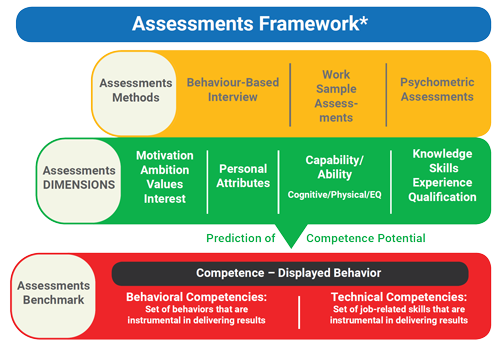
 Technical competencies are a set of job-related skills, knowledge and abilities that are necessary in successfully doing the job and delivering results. Behavioral competencies (“soft skills”) are a set of behaviors based on values, personal traits (attributes), attitudes, habits and experiences that are necessary for success in the job and in the workplace.
 Profiling is the recording and analysis of a person’s psychological and behavioral characteristics to assess or predict their capabilities in a certain sphere or to assist in identifying a specific subgroup of people. While screening separates people into different groups based on available data, profiling often extrapolates from existing data, and groups people based on inferred characteristics.
DDT programs leverage sophisticated assessments to select high potential candidates for their programs, to evaluate progress of students during training, and to optimize the matching of graduates to avaialble employment opportunities.
Assessments Framework
This Assessments Framework describes a comprehensive approach for evaluating job seekers against a specific job role. For each job role, it is important to first define the “benchmark” (norm, point of reference, standard) or the expected levels of both technical and behavioral competencies. Next, the Framework identifies which cognitive and non-cognitive dimensions are predictors of those competences. Finally, the Framework suggests various methods for assessing those dimensions.
Types of Assessments in Education:
- Standardized tests
- Formative vs. Summative Assessments Interim
- vs. Final Assessments
- Screening vs. Placement Assessments
- Performance vs. Portfolio-based Assessments
Assessment Methods:
- Questionnaires vs. Tests
- Self-Assessments
- Computer-based Assessments (CBA)
- vs. Pencil and paper Assessment
- Mobile Assessments
- Unproctored Internet Testing (UIT)
- vs. On-site testing
Types of Assessments in Workplace:
- Observation
- Behavioral Based Interview
- Work Sample Assessments
- Psychometric Assessments
 Benefits of Screening, Assessments, and Profiling

For the young student/trainee/job seeker:
- Practice assessments help students prepare for the actual assessment and increase their probability of achieving higher results.
- Self-assessments provide young people with a more realistic perspective on their strengths and weaknesses for the job market, and can guide their education and career choices.
- Discussing test results with a caring adult can empower the
young person to work harder and smarter toward success.

For the employer/hiring manager/human resources:
- Screening assessments reduce the overall costs of hiring by eliminating applicants who are clearly not fit for the job, and identifying a smaller group of potential job candidates who are then evaluated using costlier and more time-consuming assessments (such as interviews and tests).
- Using well-developed, valid and consistently applied assessments, employers make better talent decisions (hiring, training, promotions, etc.), which ultimately impacts organizational effectiveness.
- Decreases the risk of job candidates and employees filing justifiable legal complaints against the employer.

For the teacher/trainer/educator:
- Formative assessments can guide teachers on how to improve the instruction approach and content to optimize students’ results.
- Assist educators and trainers in identifying students with special learning needs, diagnosing learning disabilities, evaluating language quality and determining eligibility for specialized education services.
- Job-related assessments assist educators in identifying gaps between students’ skills and employers’ requirements, and aligning curricula to close that gap.
- Workplace skills assessments help teachers understand employers’ expectations, and support young people’s development, leading to increased chances that graduates will be successful in obtaining, retaining and progressing in their jobs.

For the community:
- Standardized assessments provide insight into education achievement of students overall and into the quality of education in a certain area.
- Hold individual schools and the public education system and officials accountable for improving academic achievement of students.
- Offer the opportunity to evaluate and compensate teachers, at least partially, on the test scores of their students, leading to higher motivation, engagement and retention of teachers.
 Best Practices
For educators when preparing students for the workplace:
- Implementing realistic employment assessments in schools can assist students and teachers to better understand employers’ expectations.
- Before adopting any assessments, their validity and utility must be checked; further, there are legal limitations to using certain assessments, and those must be taken into consideration before administering any tests.
- After scoring an assessment, discussing test results with the student in an encouraging and tactful way, can empower the young person to work harder and improve.
- All assessments must be fair and perceived as such.
- Technology can enhance the assessment process and reduce the costs of assessments.
Self-assessment is a valuable tool and should be considered with other assessment methods.

For developing the assessment process for a specific job role:
- Define the competency profile (skills, experience, knowledge, personal attributes, etc.) that ensures success in the job role.
- Design the assessment process and choose assessment tools (system), combining various assessment methods that correspond to that profile.
- Train assessors on the chosen assessment process, techniques and instruments, and implement the approach consistently.
- Collect information over time, and evaluate and improve the assessment process as necessary.
For employers/hiring managers:
- Assessment must be aligned with business purpose.
- Test both technical and soft skills and focus on job role specific skills.
- Select the optimal assessment methods and types, then combine them to optimize the accuracy of decision making and return on investment.
- Personalize each skills assessment to those who will be assessed, and offer your candidates/employees adequate testing resources.
- Periodically evaluate your assessment approach and tools to ensure validity (job relatedness) over time.

Characteristics of a good assessor:
- Must be recognized and respected as a good assessor (has a positive track record).
- Has extensive knowledge of the industry in which the assessment is being conducted, including best practice standards.
- Has a relevant work history in the same or related industry.

Pitfalls to avoid during assessments:
- Using subjective judgment (intuition).
- Having untrained interviewers and assessors.
- Using inconsistent ratings offered by multiple observers who were not following the same agreed-upon criteria.
- Reliance on a single assessment method.
- Taking shortcuts during assessment process development.
Examples of Assessments and Screening:
 WorkKeys Assessments by ACT measures essential workplace skills (applied math, graphic literacy, and workplace documents) that can affect job performance and increase opportunities for career changes and advancement. These assessments are the base for the National Career Readiness Certificate (NCRC) in the United States.
 Tessera by ProExam is an online tool for measuring six noncognitive skills and character strengths in middle and high school students (tenacity/grit, organization/responsibility, teamwork/cooperation, composure/resilience, leadership/communication, and curiosity/ingenuity).
 ELSA (English Skills Literacy Assessment) by EOH and Kaleidoprax Institute is a language, norms-based, group-measuring instrument that can quantify and diagnose a respondent’s English language (and numeracy) skills performance, equating the competency-input performance level to that of a South African English mother-tongue peer. All first-year students at Tshwane University of Technology are tested using ELSA.
 Grit Scale by Dr. Angela Duckworth is a free test of grit, considered to be one of the best predictors of success in both workplace and life. Grit in psychology is a positive, non-cognitive trait based on an individual’s passion for a specific long-term goal, coupled with a powerful motivation to achieve it.
 Shadowmatch is an online assessment used by employers for recruitment. Shadowmatch is based on comparing the habits of the individual to that of the top performers to determine the anticipated propensity for the individual to succeed in doing the same job under the same working conditions as the top performers.
 Roma by CareerHarmony is a platform for recruiting, screening and managing talent, available in 21 languages, and in 50 countries. CareerHarmony offers a wide range of tests to assess capabilities and skills for specific job roles, along with psychometric tests to determine aptitudes and personality traits, and compare them with job requirements.
 Harambee is a youth employment accelerator in South Africa connecting young work seekers with employers looking for entry-level talent. Harambee screens candidates based on their age (18-34), citizenship (South African), education (matric – high school graduation), length of unemployment (at least six months) and criminal record (none). Eligible candidates are then tested and interviewed in person.