
About the Demand-Driven Training Toolkit for Youth Employment
 Goal: The goal of the Demand-Driven Training for Youth Employment is to accelerate the scaling of world-class demand-driven training (DDT) youth programs and to promote the best and most promising practices in DDT to successfully prepare and transition young people into sustainable jobs. The Toolkit’s precursor document, the Demand-Driven Training Framework, presents background on the
 How we gathered the information: Both the framework and toolkit are based on a review of the literature, and interviews and site visits with ten leading DDT providers operating in South Africa and globally. Input and feedback were gathered from many along the way.
 What each document does: The framework serves as a roadmap for demand-driven training, and describes its building blocks: inputs and activities, outputs and impacts, and constraints and opportunities. The toolkit provides in-depth information on the most important processes and characteristics of DDT models, specifically outlining: definitions of terms, benefits to various stakeholder audiences, best practices, relevant global examples, and practical resources.
 Audience: The DDT Framework and Toolkit were created for youth development practitioners; educators and trainers; program managers and administrators; and all those who design, develop, deliver and fund youth education and training programs.
 How to integrate in your own work: Acknowledging that there is no single algorithm for creating an effective training for employment initiative, the toolkit aims to support better alignment of existing or new youth programs with employers’ expectations and labor market demand for skills. Depending on the complexities of each context, target group and economic sector, DDT lessons learned and recommendations captured in the toolkit must be customized and adjusted for local implementation.
The Challenge of Youth Unemployment
Across the world, youth unemployment, under-employment, and inactivity remain some of the most critical challenges for communities, families, and young people in both developing and developed countries. Of the roughly 1.8 billion young people today, about one third can be described as NEETs – not in employment, not in education and not in training. Approximately 40 percent of all unemployed people are youth.
Evidence shows that demand-driven youth training interventions that closely involve employers yield benefits with regard to youth employment and incomes*. In such initiatives, new training content is created, or an existing curriculum is modified, based on intense discussions and feedback from employers interested in hiring program graduates. In many cases, training simulates the workplace environment of those employers’ firms. Other program elements, such as recruitment and the selection of candidates, job matching, post-hire support, definition of staff roles, and instructor profiles, are also tailored to align the service delivery with the specific expectations of engaged employers.
The DDT concept has been in use for some time in youth workforce development and was highlighted in the 2013 Rockefeller Foundation study on promising skills training models for information and communication technology (ICT) enabled employment opportunities. Youth skills development programs can be classified based on their market alignment in three categories, as defined by Making Cents in a study sponsored by Microsoft:

Demand Aware
Programs train youth for jobs in a number of high-growth sectors by focusing on developing their general work readiness skills.

Demand Aligned
Programs prepare youth for jobs in a specific sector.

Demand Driven
Programs develop and prepare youth for specific job roles.
DDT youth programs build job-relevant skills, defined as “a set of competencies valued by employers and useful for self-employment.” To best accomplish this, DDT programs offer both pre-employment skills development and some form of on-the- job training, through internships, apprenticeships or learnerships.
Demand-Driven Training Framework
DDT refers to those skills development initiatives that are customized to respond directly to specific requirements of a job role for an employer or a group of employers, and lead to placement in employment or self-employment. Here’s how it works:
Demand-Driven Training Framework
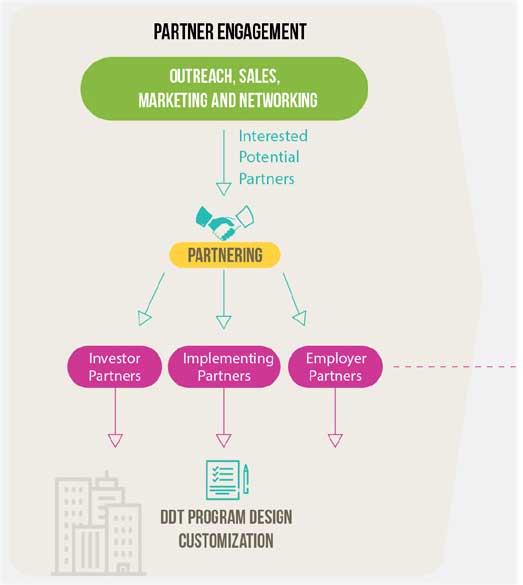
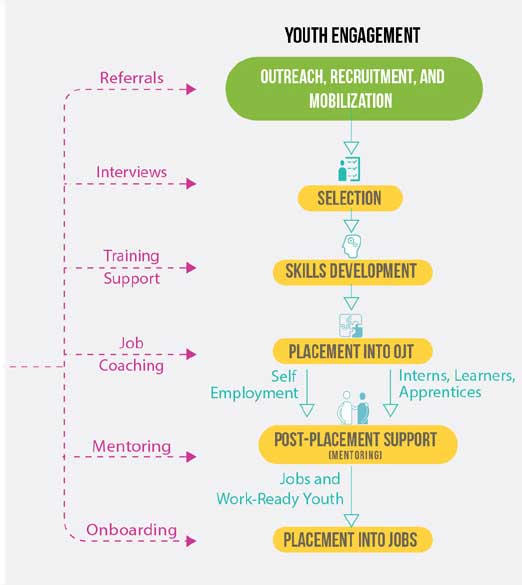
Demand-Driven Training Support Process
LMI Analysis
Administration & Financial Support
Communication & Public Relations
IT Systems Management & Support
Monitoring & Evaluation